
Texas Court Record Requests
Try re:SearchTX first when the case might sit in a participating Texas trial court. It can return case, filing, document-text, and hearing results for eligible matters. Coverage has limits, though. No tool proves that every Texas court or case type is included, and the complete Texas trial docket and official file still belong to the court's clerk. Run Docket Search to pin down a cause number. Confirm the county and court before you order anything.
- Search the statewide Texas index and note the case number, court, county, and filing date. A search result can help locate a record but does not prove that every Texas filing image is available.
- Match the Texas court on the notice or case result to its clerk. District, county, probate, justice, and municipal cases can have different custodians, even in the same county.
- Open the correct clerk’s online record system through Browse Counties. Check the Texas office’s search range, document options, and current request instructions.
- If the file is not online, ask the clerk by phone or email, use a courthouse public terminal, or visit the clerk’s records counter. Ask whether that Texas clerk accepts mail or fax requests and which payment methods it supports.
- For a paper or electronic certified copy, name the exact Texas document and ask the Texas clerk for its certification and delivery charges. A docket index is not itself a certified copy.
One local example of the pattern is the Travis County District Clerk's records page, which walks visitors from online case information to copy requests. Keep in mind that its tools and steps are local practice, not statewide rules.
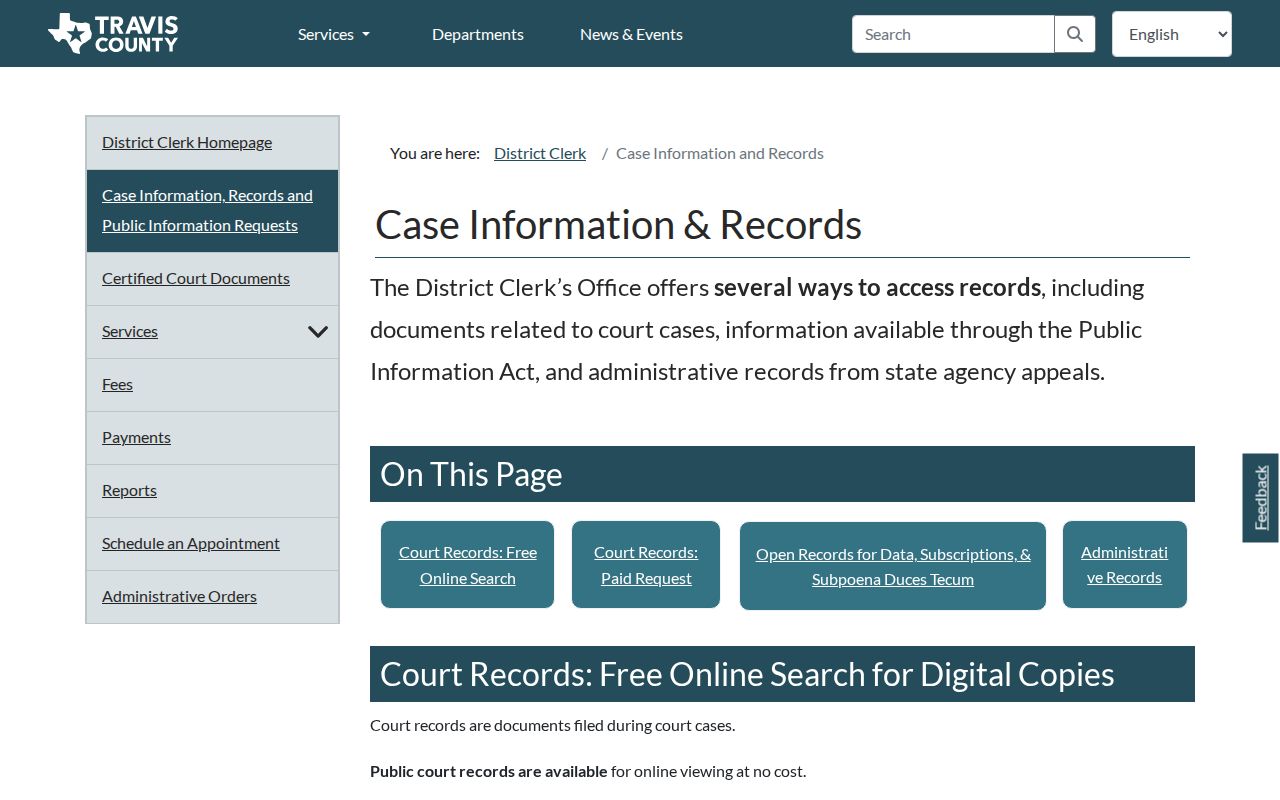
That county page shows the pattern. A statewide result is a starting point; the county clerk remains the source for the full Texas record.
Texas District Clerk vs County Clerk Records
No single statewide clerk stores every Texas trial case. Records split by court level. District Clerks keep Texas District Court records, which commonly cover felony, district civil, family, and juvenile matters. One district can span more than one county. A single county can hold multiple District Courts. Match your request to the court name and county on the filing itself.
County Clerks in Texas hold constitutional County Court records. They also hold many county-level civil, misdemeanor, and probate files. County Courts at Law and statutory probate courts sometimes have a locally assigned clerk. Some counties use a separate probate office instead. Justice Court clerks keep their own civil, eviction, small-claims, and fine-only cases. Municipal clerks handle city-court and ordinance records. OCA supports Texas court administration and data programs. It is not the central custodian of those case files.
To find the right office, use the Texas Judicial Directory to identify a court and its location. Then check the county clerk page for local file and copy instructions. Clerk assignments for statutory County Courts at Law and probate courts vary. Confirm the actual Texas custodian before you send anything.
Texas Court Record Types
A Texas court file can hold a case register. It may also hold filed pleadings, notices, motions, signed orders, judgments, and exhibits. The public Texas docket or register lists case events. It may link to some documents. Not every filing image is online or open, though. Another record to know about is the court reporter's transcript. The reporter produces that, rather than the clerk.
Federal cases sit outside Texas state-court records entirely. Federal trial cases in Texas run through PACER. State trial cases route through the county clerk and eligible statewide services. The official PACER access page describes how federal case search and public access work.
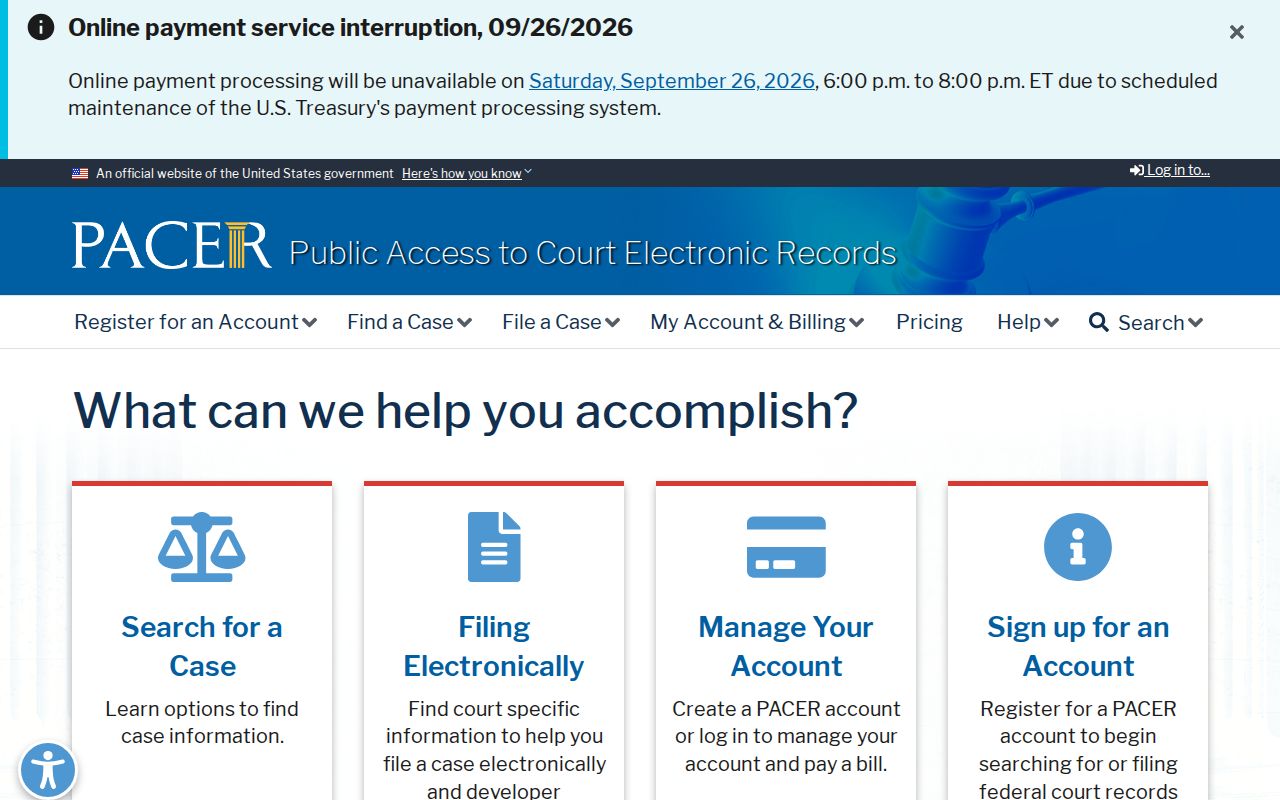
The two systems do not overlap. A federal search result will not replace a Texas county clerk's docket, and a state-court index will never include a federal case file.
Texas Court Files and PIA Requests
Send a request for a petition, docket sheet, or judgment straight to the Texas clerk holding that case. Texas court records do not move through the same channel as ordinary requests to executive agencies under the Texas Public Information Act, Government Code Chapter 552. The statute excludes the judiciary from its definition of a covered governmental body. A county clerk may still handle separate administrative records under the act. That applies when acting in a covered role.
Judicial administrative records follow a different path. Texas Rule of Judicial Administration 12 and OCA's open-records policy cover defined judicial administrative records held by custodians within the rule's scope. They draw a line between those materials and records tied to adjudicating a case. Rule 12 does not reach elected officials other than judges. That includes district clerks. A covered judicial record request goes in writing to its custodian. The rule's review process kicks in if access is denied. Never send an ordinary Texas case-file request to OCA as a PIA request.
Unsure what the document is? Describe the record and ask the custodian which process applies. The clerk, court administrator, or county public-information contact may differ. It depends on whether the material is a case record or an administrative one.
What a Texas Court Record Holds
A Texas case file grows piece by piece over time. The case number and court identify the matter. The register lists dated events, while filed papers and signed orders supply the underlying text. Texas case numbers are assigned locally. No single format works across every Texas court and county.
| Cause number | The local case identifier. Give the number with the court name and county when asking a clerk to locate the file. |
|---|---|
| Case parties and type | The caption and case category help distinguish matters with similar names or causes filed in different courts. |
| Docket or register | A Texas chronological event list with filing descriptions, settings, and case status. It is not the filed document itself. |
| Pleadings and orders | Texas petitions, answers, motions, notices, signed orders, and final judgments, subject to availability and access limits. |
| Exhibits and attachments | Evidence or supporting files may be linked, stored separately, redacted, sealed, or unavailable through a public search. |
Name a specific document and date when you can. A request for "the whole file" means more clerk work, and exhibits or older paper records may follow a separate retrieval path. Also remember that Texas courts share no statewide case-number format, so give the clerk the issuing court and filing year when you ask for a search.
Texas Dockets, Documents, and Transcripts
One Texas case search can return several different records. The statewide result works as an index. A county register, kept by the clerk, lists events in order. The filed document itself holds the pleading or order, and a court reporter's transcript captures what was said in the proceeding.
- Index result
- A case summary returned by a search tool; it can point to the clerk that holds the underlying file.
- Docket sheet
- The official chronological list of case events maintained by the court’s clerk.
- Filed document
- A pleading, order, judgment, notice, or exhibit stored in the court file.
- Certified copy
- A clerk-authenticated copy of a specified record, issued in a format accepted by the receiving institution.
- Transcript
- A written record of proceedings prepared by a court reporter, separate from the clerk’s docket and file.
Certification from a Texas clerk means one thing only. It confirms a copy matches the file in that office. It does not validate the document's claims, nor does it turn a docket summary into the filed order itself.
Court Record Fees in Texas
Texas sets no single copy price. No one rate covers every county clerk, District Clerk, JP court, municipal clerk, portal, or reporter. Page count, certification, delivery, and payment charges all interact with statutory fee categories. Local schedules shape them too. A free index does not make a clerk-performed search or a certified record free. Filing fees stay separate from copy fees.
Local Government Code Chapter 118 governs many County Clerk fee categories. Government Code Chapter 51 covers District Clerk costs. Local schedules, delivery services, and payment processors still shape the final total.
One current local example is the Travis County District Clerk's schedule effective January 1, 2026. It is not a statewide rate. That schedule lists these District Clerk services:
| Record / Service | Travis County, Texas example | Scope |
|---|---|---|
| Search | $5 per name or item | Clerk-performed search in this local schedule. |
| Paper copy | $1 per page | Plain paper copy; not a certified document. |
| Electronic copy | $1 for the first 10 pages, then $0.10 per added page | Non-certified electronic copy under this schedule. |
| Certified copy | $5 per document, plus copy charges | Certification is a separate charge. |
| Exemplification | $5 added per document | Additional authentication for uses that require it. |
| Card processing | 3%, minimum $3, nonrefundable | Local processing charge, not a statewide record fee. |
The Travis County District Clerk fee page displays the local charges summarized here.
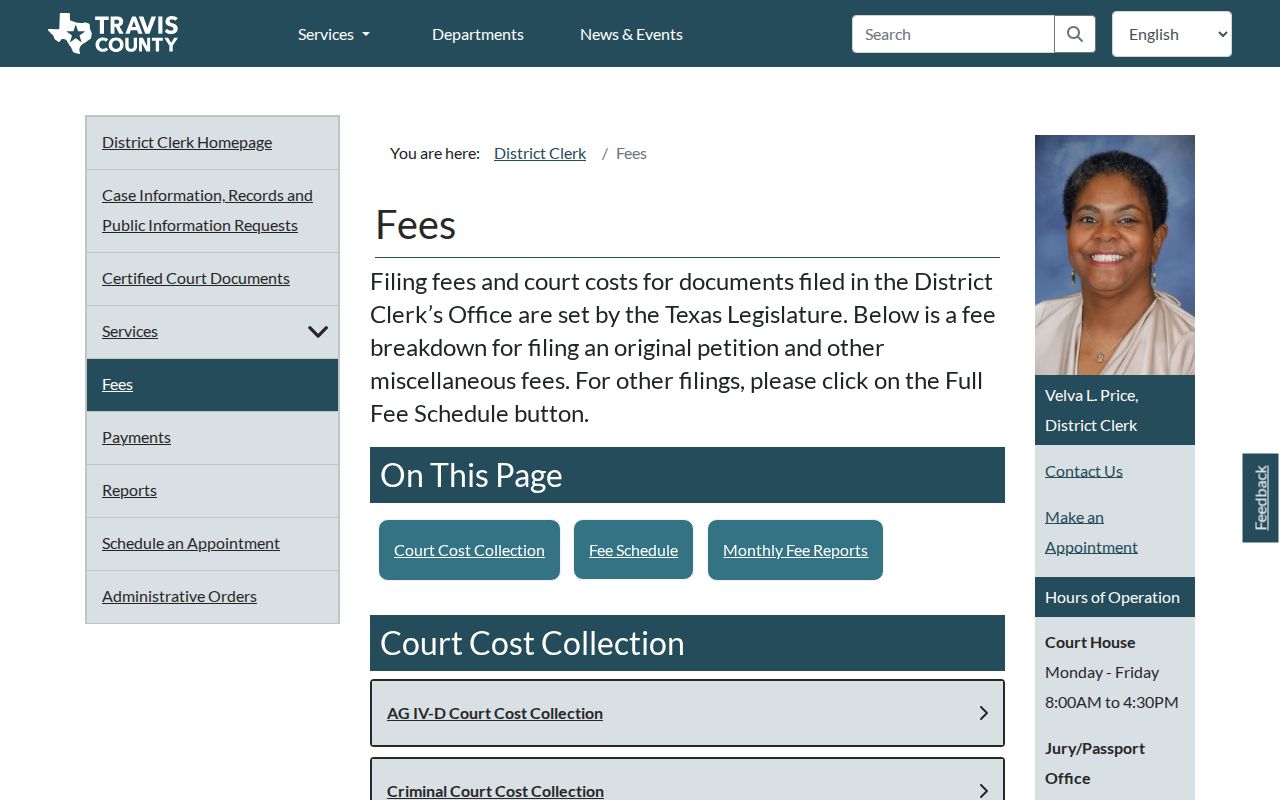
Check the relevant county clerk's current fee page before you pay. Travis County's published amounts do not set prices for other Texas courts. Note: These figures apply only to the Travis County District Clerk, on the effective date shown on that schedule.
Texas Court Records Missing Online
An old Texas case may sit outside a portal's conversion range. It may also fall outside a county's online index. Start with the statewide Texas portal for a lead. Then contact the clerk for the Texas court that heard the matter. Give the court name, an approximate year, a party name, and any cause number. Ask whether docket books, microfilm, scanned archives, or off-site files cover that period.
Request a defined record, such as a final judgment or docket sheet. Ask how to pay for any archive search or copy. Some clerks accept a form by mail or email. Others require a request at the counter. A missing online image does not mean a file was destroyed, sealed, or never filed. Processing times are local. Texas sets no statewide delivery deadline for an ordinary case-copy request.
Texas Record Access and Sealing
Many Texas court filings are open to inspection. Access still depends on statutes, court rules, and case-specific orders. A public index can stay visible even while a document image is redacted or restricted. Family, juvenile, adoption, mental-health, guardianship, protective-order, and sealed matters each follow different Texas rules. Treat none of them as one blanket category.
Key Texas rules:
Texas Rule of Civil Procedure 76a sets a process for sealing defined civil court records; a court order and the rule’s findings matter.
Texas Rule of Civil Procedure 21c requires specified sensitive information to be redacted from electronically filed documents.
Texas Family Code Chapter 58 restricts access to specified juvenile records, with statutory exceptions and access tiers.
Texas Code of Criminal Procedure Chapter 55A governs expunction; nondisclosure orders for covered cases are governed by Government Code Chapter 411, Subchapter E-1.
When access to a Texas court record is limited, ask the clerk which rule or order applies. Also ask whether a public redacted copy exists. Neither a portal setting nor a general PIA request can lift the restriction. Note: A visible case index does not mean every linked filing is public. It may not be available in unredacted form either.
Texas Court Reporter Transcripts Come Separately
A Texas transcript is a word-for-word record of a hearing or trial. The official court reporter prepares it. It is not the clerk's docket sheet, a filed exhibit, or a certified copy of an order. Ask the reporter, not the clerk's records desk, for the date range. Also ask about the written request process, estimate, and delivery terms.
Texas Government Code §52.047 addresses transcript preparation and delivery in covered circumstances. The reporter's charges and workload differ from the clerk's copy schedule. On appeal, the appellate docket may show whether a reporter's record was requested or filed. The reporter prepares the transcript while the trial clerk supplies the clerk's record. Note: A transcript and a certified clerk copy are separate products, even for the same hearing.