
Traffic Cases in Texas Courts
Texas has no single traffic court tier. A city citation usually lands in the municipal court named on the ticket. Tickets written in a county or an unincorporated area may go elsewhere. The destination there is a Justice of the Peace court. Read the issuing agency and court name printed on the citation before anything else. City boundaries, precinct lines, and Texas court assignments all shape where a case gets filed.
The local court keeps the docket and its final order. The Texas Department of Public Safety (DPS) handles driver licensing and eligibility. TxDMV runs Texas vehicle registration. Those systems answer different questions. Your case number, plea, payment, setting, and final order live in the local case file. A license renewal hold or registration flag may rest on a separate report. That report is filed by a participating court.
Texas Has No All-Ticket Search
A Texas ticket can come from several places. The issuer may be a municipal police department, a sheriff, a constable, a DPS trooper, or another agency. Nothing pulls all of those into one public statewide citation database. The citation itself names the Texas court that took the case. Search that court or call its clerk when statewide tools come back empty.
Two statewide services get mistaken for a full ticket search. DPS runs a limited lookup for Texas Highway Patrol citations from the previous 24 months. The Texas courts' Citation by Publication search covers legal notices used for service or publication. It does not cover speeding tickets or red-light citations. Neither one replaces a municipal or JP court docket.
Note: A ticket missing from the DPS search may fall outside its 24-month range. Or it may have been issued by an agency other than the Texas Highway Patrol.
How Texas Tracks Citations Statewide
Statewide services sit above the local docket, but only for narrow slices of data. The DPS lookup takes driver identification details for eligible Highway Patrol tickets. A separate failure-to-appear or failure-to-pay program can carry reports from courts that join by contract. The Texas court still decides the case. It records the outcome. The table below sorts out those state and local roles.
| System | What It Holds | Run By |
|---|---|---|
| DPS Highway Patrol Citation Search | Texas Highway Patrol tickets issued in the prior 24 months; all driver-identification fields must match. | Texas DPS |
| Failure-to-appear / pay license reporting | Certain unresolved matters reported by participating local courts or governments under contract. | Local reporting court and DPS; OmniBase supports lookup for participating courts. |
| Citation by Publication search | Texas legal notices and citations for service or publication, not traffic tickets. | Texas Office of Court Administration |
| Driver licensing and eligibility record | License status and reported eligibility restrictions, separate from the court register. | Texas DPS |
| Vehicle registration restriction | Local registration hold where an eligible city or county participates. | Local government or court reporting to TxDMV. |
The Texas DPS Search Covers Highway Patrol Tickets
The DPS Texas Highway Patrol Citation Search is narrow by design. It covers qualifying citations from the prior 24 months. Those must be written by a Texas Highway Patrol officer. Tickets from other police departments, sheriffs, or a Texas municipal court do not appear. So it is not a statewide search of traffic dockets.
The form asks for a driver license or identification number, date of birth, first name, and last name. Each field must match the license information given when the citation was issued. If the search returns nothing, confirm the issuing agency, date, and court on the ticket. A match can help you locate the matter. But payment or a plea goes through the court named on the ticket.
For the case history, use the Texas court's local portal or records clerk. For a hearing date, check the court calendar and formal notice. A calendar row is only a schedule entry, not the whole citation file.
Note: DPS sends ticket payment and plea questions to the issuing court. That court stays the authority for the case docket.
Texas Traffic Ticket Lookup Steps
Let the court name and citation details on your ticket drive the Texas lookup. Never assume a statewide search pulls in a city ticket or a JP case. The local court can tell you whether the matter is open, what response is due, and which record-copy options it offers.
- Read the citation for the issuing agency, court, city or precinct, and case number. If the paper is unclear, ask the issuing agency which court received the citation.
- For a Texas Highway Patrol ticket from the previous 24 months, try the DPS lookup using all required driver-identification fields. Other Texas tickets may not appear there.
- Open the Texas court named on the ticket. Use the Browse Counties directory for a county JP or other county court; use the city’s official municipal court path for a city citation.
- Confirm the case number, court, amount or response option, and date on the court’s own record. The ticket and current court notice control any deadline.
- Ask the local Texas clerk for a docket sheet, signed disposition, or copy. For the upcoming setting, use the Texas Court Schedule page to find the local calendar route, then confirm with the court.
Keep proof of any payment, plea, or hearing request. A saved receipt helps the clerk trace a posting question. Still, the official docket entry and final court order control the case status.
Texas License Holds Need Court Clearance
Texas Transportation Code Chapter 706 lets cities and courts contract with DPS. The reports cover failures to appear or pay. Not every Texas ticket triggers a hold. But when a report goes in, DPS can block license renewal until the court clears the case. The state record then catches up. The Texas case docket and the driver-eligibility record remain two different files.
If a hold lingers after you resolved the matter, call the court named on the ticket. Ask whether the case is still open. Ask whether payment or a judgment posted, and whether the court sent its clearance report. Keep any receipt or order. DPS says a driver record usually needs three to five business days to update once the court reports. OmniBase offers a lookup and support line for participating Texas courts. Even so, it is not a full traffic docket.
The DPS Failure to Appear / Failure to Pay program page walks through the court-clearance route. Chapter 706 sets a $10 reimbursement fee for covered reports, subject to statutory terms and exceptions. The local fine and court costs sit on top of that fee.
Note: Ask the court to confirm it sent clearance. Do not assume the state license record is updated.
Texas Ticket Payment and Contest Options
Texas sets no single deadline or payment channel for every municipal and JP citation. Follow the instructions printed on the ticket plus the issuing court's current rules. Want to contest the citation or ask about deferred disposition? Check with the court before you pay. Paying can enter a plea. That can lead to a Texas docket disposition.
| Paying in Texas | Contesting in Texas |
|---|---|
| Use the payment method listed by the court. Check whether payment enters a plea or resolves the case. | Contact the court to enter the response it requires and ask how a hearing or trial setting is scheduled. |
| Follow the response date on the citation or the court’s current notice. | Meet the same court-set response requirements and keep proof of any filing or request. |
| Save the receipt and confirm the docket reflects the outcome. | Check the next hearing date and the latest signed order or notice. |
Missed date or payment: Some Texas local courts report eligible failures under a Chapter 706 agreement, which can affect a Texas license renewal. Contact the court named on the ticket to ask what the docket shows and how to resolve or clear the case. Do not assume every ticket has the same hold or consequence.
A license hold and the local court case live in separate systems. The court records the plea, hearing, judgment, and payment. DPS updates eligibility only after it receives the right report. Keep the court receipt. Follow up with the reporting office if the records disagree.
Texas Chapter 45A Changed Fine-Only Procedure
Justice and municipal courts in Texas now run on Code of Criminal Procedure Chapter 45A. It replaced Chapter 45 effective January 1, 2025. The chapter governs fine-only offenses and includes procedures that matter for traffic citations. A court's current Texas forms should be read against Chapter 45A. Do not assume older language still applies.
Deferred disposition and a driving safety course are court options, not automatic dismissals. Eligibility turns on the offense, statutory exclusions, and the judge's decision. The court may set conditions and require proof of completion before any final dismissal. A Texas docket can show a deferral first. Later entries show compliance and disposition.
The current Texas Code of Criminal Procedure Chapter 45A is the official procedural source. Ask the issuing court which forms and terms apply to your ticket.
Texas Photo Rules Have a Narrow Scope
Texas Transportation Code Chapter 707 covers photographic traffic-signal enforcement systems. It has its own restrictions and transition provisions. The statute is narrow. It says nothing sweeping about every camera, automated notice, or speed-enforcement method. What matters is the type of Texas notice and which authority issued it.
When a camera notice arrives, check the authority it names. It may be a municipal court, another local authority, or an administrative process. Then ask that office what record it keeps and whether a court docket exists. The notice may not show up in DPS's Highway Patrol search. It may not appear in the statewide citation-by-publication tool either.
Texas Transportation Code Chapter 707 addresses traffic-signal photography within its defined scope, not every traffic camera in the state.
Two Records for One Texas Ticket
One Texas ticket, two files. The traffic docket and the driver record serve separate purposes. The local court tracks the citation, plea, hearing, fine, judgment, and any final order. DPS keeps licensing and eligibility data. It may receive a report from the court. TxDMV runs a separate vehicle-registration restriction when a participating local government reports one.
| Record | Local Court Docket | Texas Driver Record |
|---|---|---|
| Kept by | Municipal or JP court clerk named on the citation. | Texas Department of Public Safety. |
| Shows | Citation, case events, plea, court date, fine, and disposition. | License and eligibility information reported to the state. |
| How to check | Use the issuing court’s docket search or ask its clerk for a copy. | Use the official DPS license-status service for eligibility information. |
A court result alone does not confirm license or registration status. A hold may appear after a ticket was resolved. Ask the court which report it sent. Then contact the Texas agency holding the separate state record.
Note: Vehicle registration holds under Texas law are separate from DPS license status. Local participation affects the process.
Texas Citation Notices Are Not Tickets
The Texas courts' Citation by Publication search covers legal notices and citations used for service or publication under Government Code §72.034. You can search by name, cause number, court or county, and status. A wildcard suffix widens a text search. None of that makes it a traffic-ticket lookup.
The official Citation by Publication search screen shows the legal-notice fields and the results path.
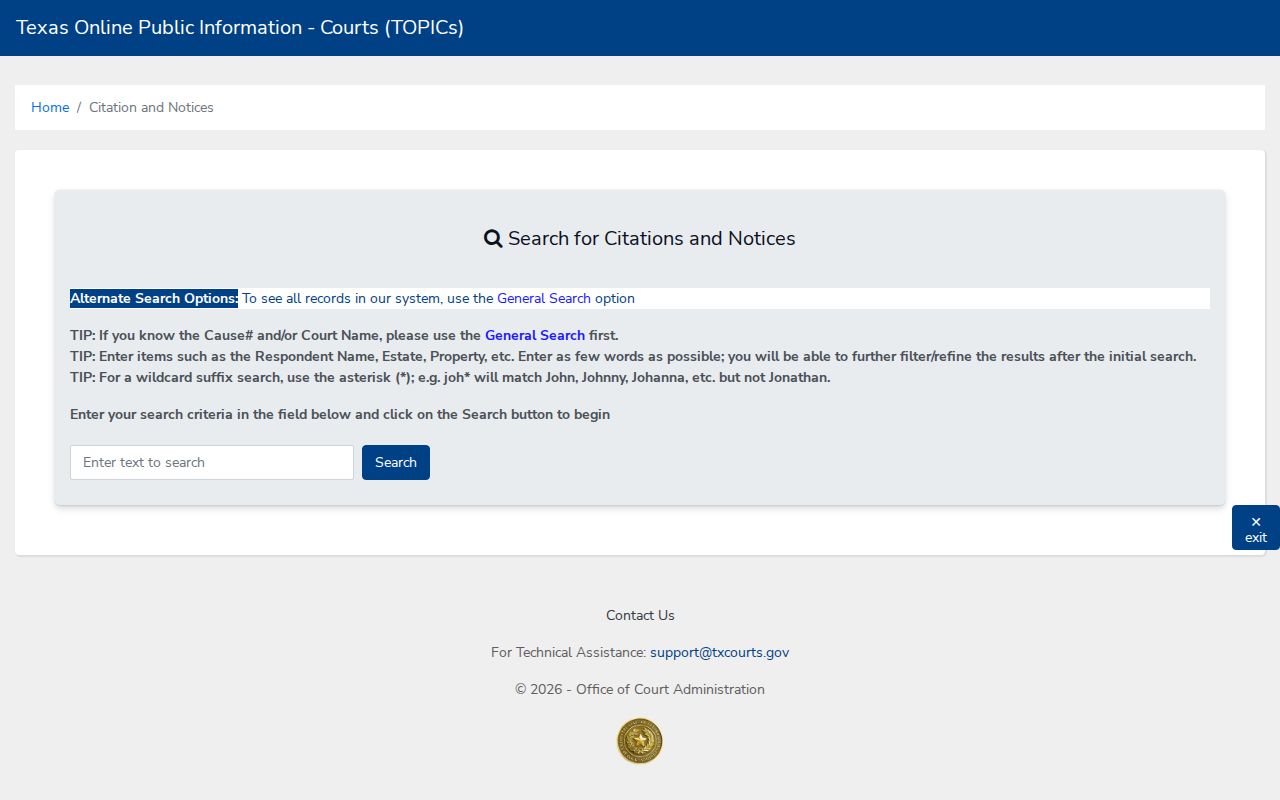
For a Texas moving violation, go back to the issuing municipal or JP court. The legal-notice portal and a traffic docket keep different records for different jobs.