
How Texas Courts Are Organized
Texas runs its judicial branch through trial courts and appellate courts. At the very top sit the Supreme Court of Texas and the Texas Court of Criminal Appeals. District Courts carry the widest load: felonies, major civil disputes, family matters, and juvenile cases. County Courts, County Courts at Law, and statutory probate courts take whatever the Constitution or their enabling statutes assign. Justice Courts handle fine-only offenses plus limited civil work such as evictions and small claims. Municipal Courts cover city ordinance matters and fine-only offenses within their authority.
Appeals go up next. Fourteen geographic Courts of Appeals hear civil and criminal appeals. The 15th Court of Appeals holds statewide jurisdiction over specified cases involving the State and appeals from the Texas Business Court, subject to statutes and current transfer orders. The Supreme Court of Texas sits at the top for civil and juvenile matters. The Court of Criminal Appeals holds that spot for criminal ones. The state's 2025 Texas judicial-system pamphlet walks through the tiers and their jurisdiction.
Which clerk holds the file depends on the court named on the case. District Clerks maintain District Court records. Texas County Clerks keep constitutional County Court records along with many county-level files; statutory-court and probate assignments vary from place to place. Justice and municipal courts run their own local dockets. The Texas Judicial Directory lists each court's type, location, and counties served. It is not a case search, though. One caution: trial, district, and appellate court maps draw different boundaries across Texas.
254 Texas Counties, 504 District Courts
The scale is enormous. The Texas FY2025 court-structure chart counted 504 District Courts. It also counted 538 county-level courts, 796 Justice Courts, and 953 Municipal Courts. Those 538 county-level courts break down into 254 constitutional County Courts, 260 statutory County Courts, and 24 statutory probate courts. Court counts are not county counts. One district can serve several counties. A single county can hold several district, county-level, JP, or city courts at once. The Texas OCA FY2025 statistical report page groups activity by court class and reporting year, which is handy for judging Texas workload scale but useless for locating a named case. These figures describe court structure, not search coverage or one uniform Texas docket system.
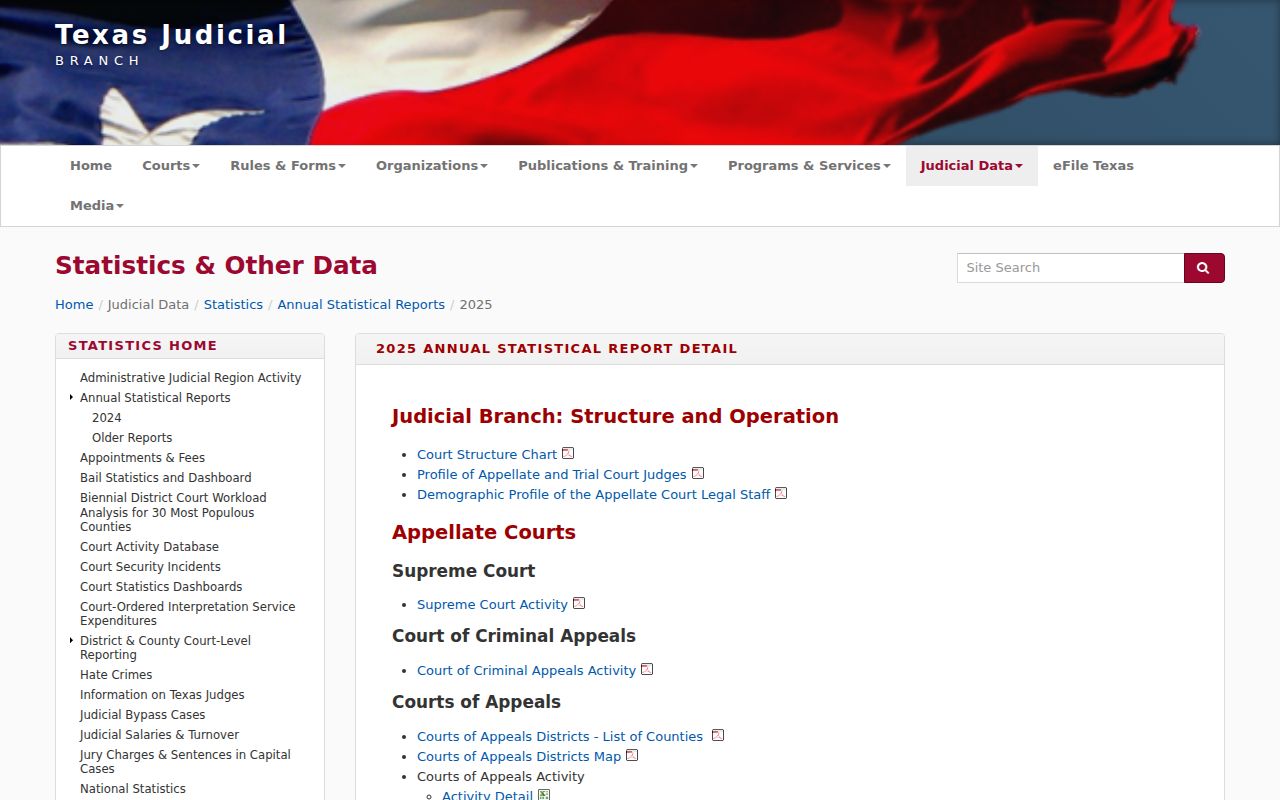
These Texas FY2025 totals describe court structure only. They are not a measure of statewide search coverage. They do not imply one uniform Texas docket system.
OCA's Texas municipal activity dataset received 10,164 of 11,460 requested reporting units. That is an 88.7 percent report rate. Those numbers reflect submitted data, so treat them as descriptions of reporting rather than complete counts of cases, people, citations, or search records.
The Statewide Portal for Texas Cases
re:SearchTX serves as the public search service for Texas cases, filings, document text, and hearings. The Texas Judicial Council Data Committee's 2024 report says the portal has operated since late 2018. The same report describes a large repository of court documents. What actually appears depends on which Texas courts feed the system and which case types they submit. That report notes the repository excludes criminal case records. Start a query with Docket Search. Then confirm the case with the clerk that maintains it.
The official re:SearchTX quick reference guide documents the search modes and the account process. It dates from 2021, so check the live portal for current dropdowns, participation, pricing, and refresh timing.
| Search area | What it can return | Coverage limit |
|---|---|---|
| Cases | Case results and case details from connected court sources. | Not every Texas court or case type is included; criminal records are absent from the repository described by OCA. |
| Filings | Filing details and links to eligible documents. | A filing entry does not mean every image is accessible or included. |
| Text in Documents | Searchable document text where text is supplied to the service. | Availability depends on source data and the document. |
| Hearings | Hearing details reported by participating sources. | County calendars remain the local check for a current setting. |
| Account and documents | Sign-in supports search features and document access. | The older guide describes free searches after sign-in and paid purchases for some documents; checkout controls current charges. |
A statewide label is not a promise that every county's live register is present. The portal posts no statewide refresh guarantee, so confirm any hearing or new filing with the local clerk. Feature labels and coverage can also change, so check the live service before relying on a field, document price, or refresh time.
Texas Court Statistics vs Case Search
The Texas Office of Court Administration backs the Texas Supreme Court and Texas Judicial Council. It publishes court activity statistics, administers programs, and works on judicial technology. It does not hold every trial case file. Instead, OCA's agency and judicial-data pages link out to several distinct tools, each with its own job.
The Texas Trial Court Activity Database aggregates reports from courts across Texas. It can show workload, case aging, performance, and appeals trends; it cannot confirm an individual cause number or a next hearing. Texas re:SearchTX returns eligible case and document results. TAMES handles Texas state appellate cases. The Texas Judicial Directory identifies courts, and Citation by Publication searches Texas legal notices. None of these services doubles as another. None is a docket search by a different name.
The official Texas OCA page presents the statewide administrative agency and its service links.
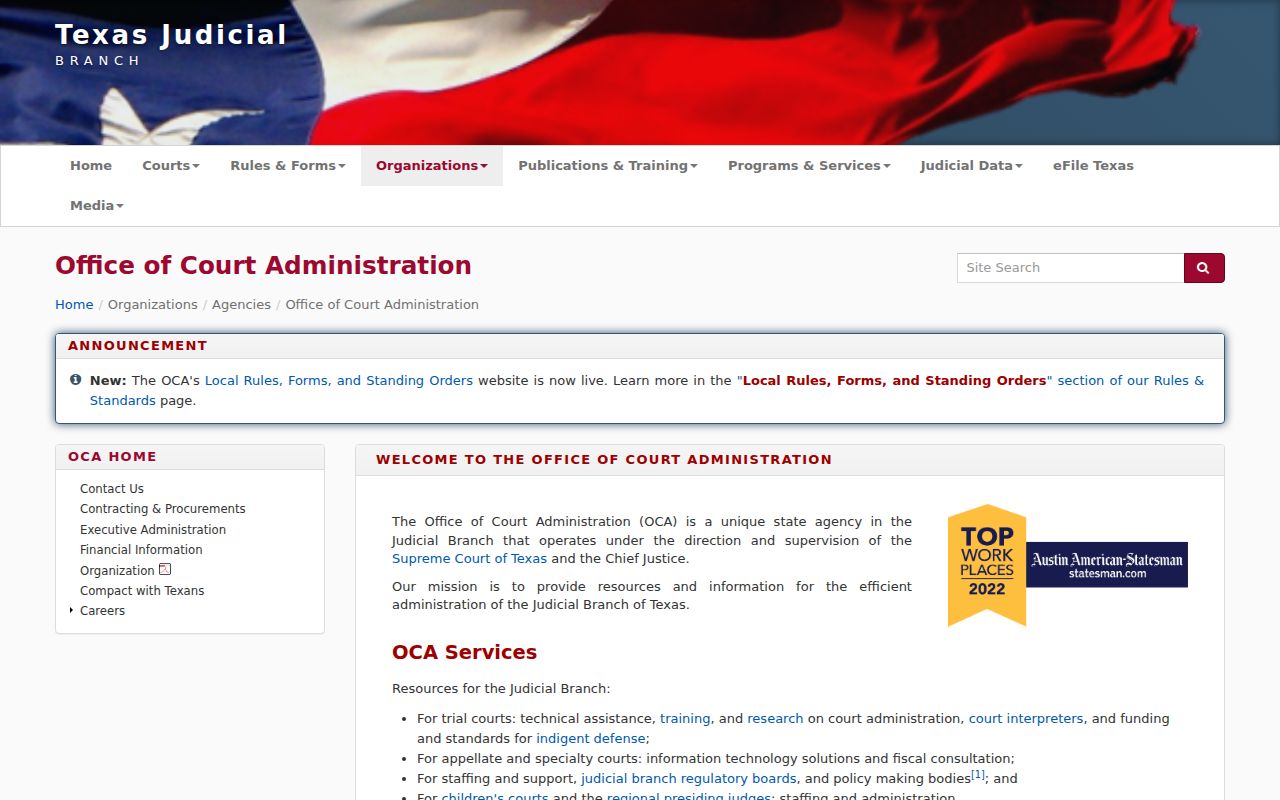
Match the tool to the question. A court case calls for the local clerk. An aggregate workload question calls for OCA statistics, noting the reporting period. Keep in mind that OCA, re:SearchTX, and TAMES return different kinds of records and cannot verify one another's live results.
From County Docket to Texas Index
Every Texas case starts local. A filing goes to the court and clerk assigned to handle it. That clerk indexes it in the county's own case-management system once it is accepted. From there, eligible data can move up to re:SearchTX through a county or vendor connection. The Texas state index gathers records from participating sources. It does not stitch every county's full event history into a single live docket. The local clerk's entries remain the detail that counts.
Case-data path: Filing with the court › Clerk acceptance and local case record › Eligible source feed › re:SearchTX index
Texas OCA sits on a separate track. Courts report activity to it for aggregate statistics, not for a public docket search. An appeal opens a new case with an appellate clerk. It becomes searchable through TAMES instead. Each layer updates on its own schedule. When a statewide result is missing, thin, or too stale to confirm a hearing, use Browse Counties to drop straight to the local court system. No statewide refresh deadline binds the local systems to the index. So treat a gap as a timing question before anything else.
Texas Cases Missing from re:SearchTX
Start with the paper in hand. Match the Texas court printed on the citation, summons, order, or notice. Confirm the county and court number, and then search that Texas clerk's own public index. Several things explain a blank statewide result. The case may fall outside a portal's conversion range. It may sit in a municipal or JP court on a separate system, carry a restricted case type, or simply not have reached the feed yet. Silence from the index proves nothing about sealing or existence.
When the gap needs closing, call the records division that owns the file. That may be District Clerk, County Clerk, JP court, or municipal court. A courthouse public terminal or counter request can reach local records the portal never shows. Older Texas cases can demand an archive search. Court coordinators explain settings; the clerk keeps the file. The Travis County courts portal is one county's local entry point for docket and calendar tools. It is an example of the route, not a coverage model for the state.
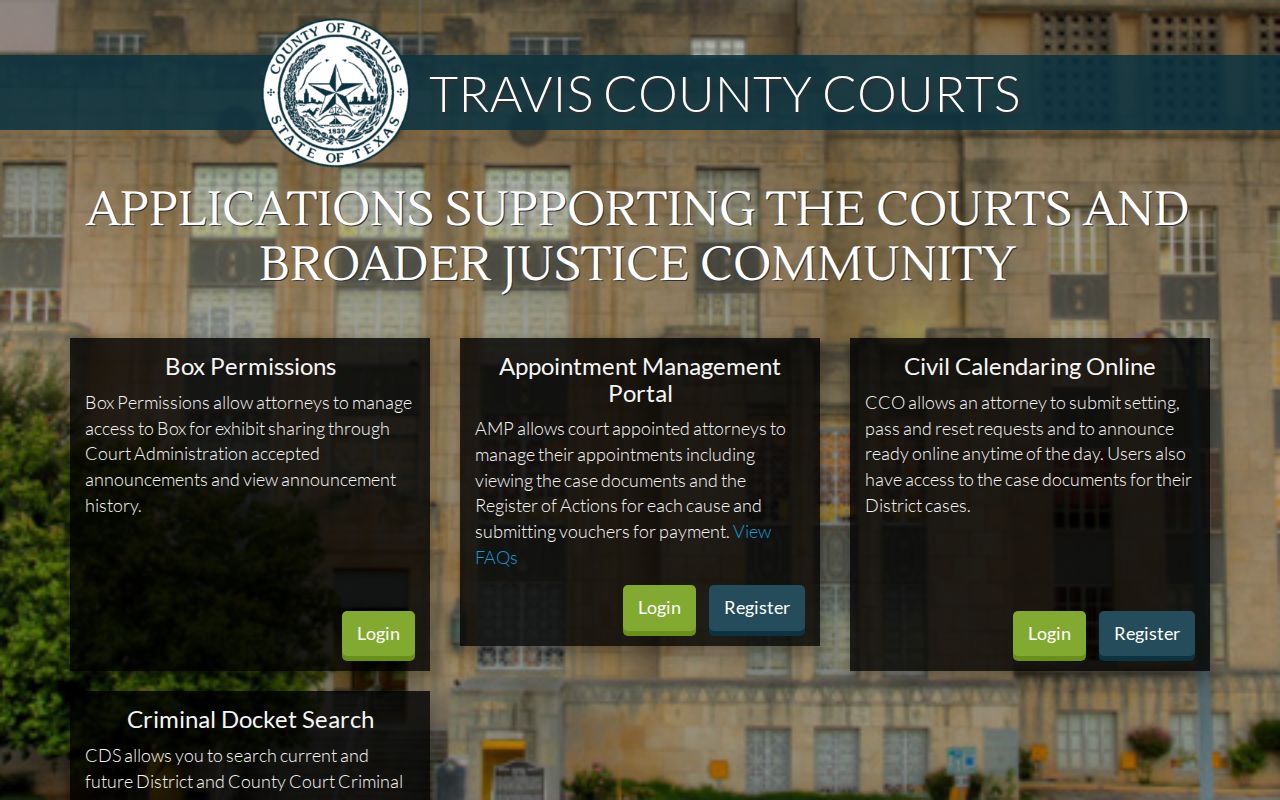
Local search tools like these show the practical lesson. Name the court on your own case papers first, then work through that county's clerk.
How eFileTexas Feeds the Docket
eFileTexas is the statewide electronic filing program. It is run under OCA and the Judicial Committee on Information Technology. A lawyer or other eligible Texas filer submits documents through an approved service provider. The program routes the submission to the chosen court. There the clerk can accept it, reject it, or return it for correction. An electronic receipt is not acceptance, and it is not a docket entry.
Acceptance is when the docket grows. The local case-management system indexes the filing. A county or vendor connection may later push an eligible event or document into a clerk portal or re:SearchTX. Filing through the program does not make a case publicly searchable there. A provider is not a source for the full docket sheet. More than twenty approved service providers offer filing interfaces. Their steps vary by provider, court, case type, and user account. The eFileTexas active-courts matrix lists participation court by court, so check it for local eligibility. Civil e-filing rolled out in phases from 2014 through 2016. Criminal e-filing reached statewide phases through 2020. JP participation varies.
The official Texas eFileTexas landing page is the filing entry point for attorneys and eligible self-represented filers.
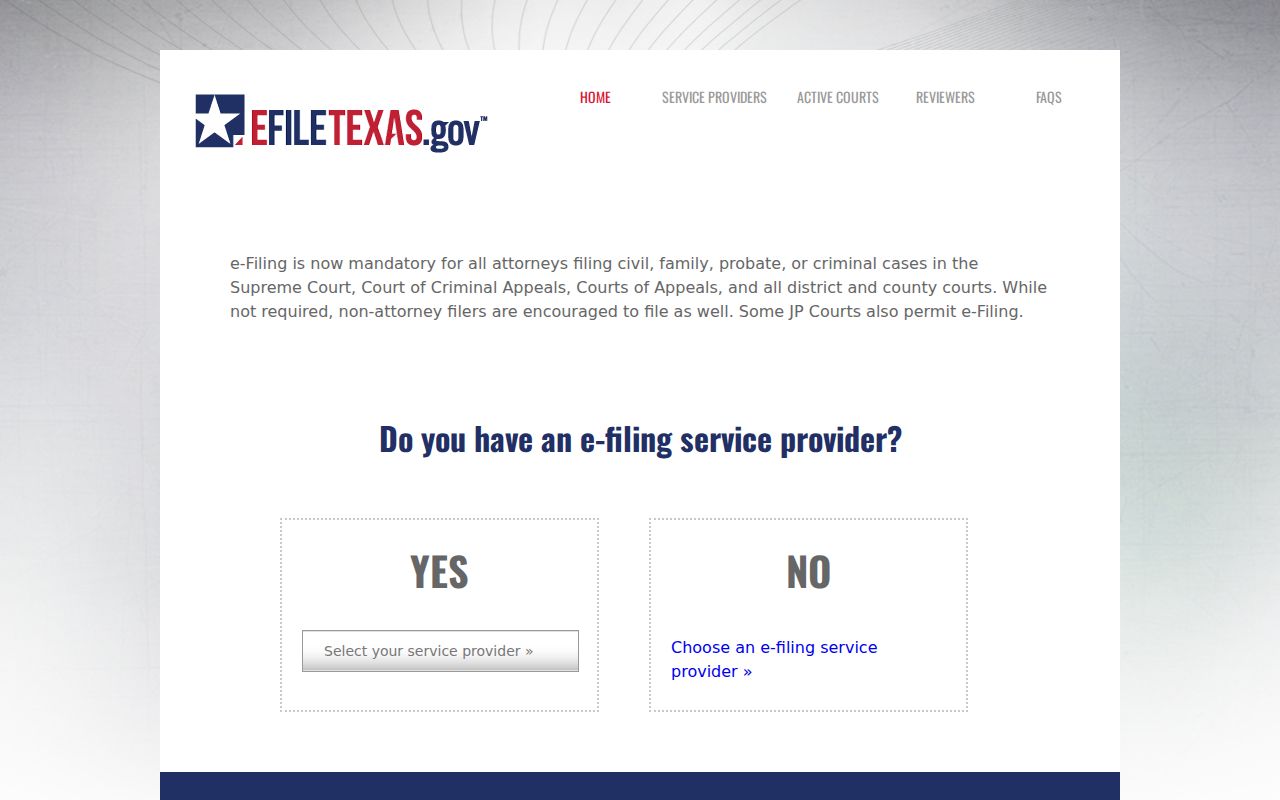
The program links a filer to one court. The accepted case record still belongs to that clerk and the local docket.
Texas Appellate Dockets Continue in TAMES
An appeal is a new case, full stop. It gets its own number and its own clerk-maintained docket in the appellate court. A trial-court number can connect the two files. But the appellate docket carries its own filings, record dates, briefing events, opinions, and mandate. The trial clerk transmits the clerk's record. A court reporter prepares the reporter's record when requested or required. TAMES is the search tool for those Texas appellate cases and documents.
It stands apart from re:SearchTX and eFileTexas. Its interface notes nightly updates and states plainly that trial-court dockets are not maintained there. A case still at trial belongs to the county clerk. On appeal, verify current status with the appellate clerk and the court's official orders. The TAMES appellate search shows its own court selector and case-search path.
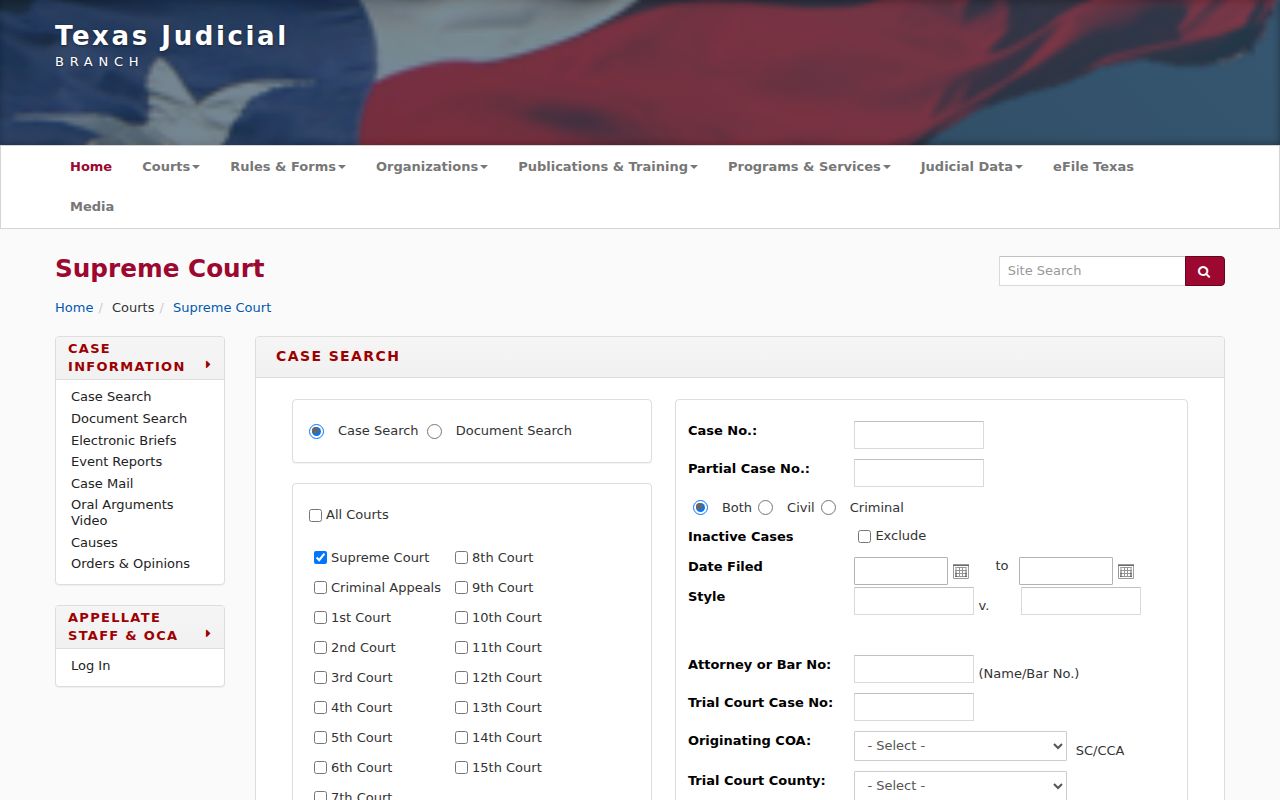
A notice of appeal, record filed, opinion, or mandate belongs to the appellate timeline. None of it replaces the underlying trial judgment.
Statewide Index vs Texas County Docket
Each search layer does a different job. Use the Texas statewide index to discover a case or find documents across participating sources. Use the local Texas clerk's records for the authoritative trial-court history, current status, missing filings, and certified copies. Neither replaces the other. A search entry is not a document, and a document image is not automatically certified.
| Record feature | Texas statewide index | Local court and clerk |
|---|---|---|
| Coverage | Records from participating sources, with case-type and historical limits. | The file keeper for a particular court; archives and online ranges still vary locally. |
| Docket detail | Case summaries, selected filings, and eligible hearing details. | Local register, event history, and clerk confirmation for the case. |
| Filed documents | Some document records and images; access or purchase limits can apply. | Copy or inspection request to the clerk for the identified case file. |
| Certified copies | Not a universal certification service. | Request certification from the clerk holding the official record. |
| Current status | No statewide refresh guarantee was verified. | Contact the clerk or court for current local information. |
Stopping at the index can cost you. A search that ends there may miss a full docket. It may also miss an older paper file or a restricted document. Keep the county, Texas court, and cause number together as you move between systems. The clerk remains the source for Texas certified copies. That holds even when a statewide result is on screen.
Texas Business Court’s New Appeal Path
Texas launched two new courts together. They are the Business Court and the 15th Court of Appeals, both live on September 1, 2024. The Business Court handles a narrow set of civil disputes that fit statutory subject and amount limits. It is not a general county civil court. It keeps its own clerk and docket separate from county records. Appeals from this Texas court head to the 15th Court of Appeals. Governing statutes and current transition orders guide that route.
The 15th Court also holds statewide appellate jurisdiction in certain cases involving the State. The other fourteen Courts of Appeals serve geographic districts instead. Check the official Texas 15th Court of Appeals information and the live jurisdiction orders. Do not assume the appellate route for any filing date before doing so.
First-year numbers stay small by design. In FY2025, the Business Court reported 185 new cases. It logged 55 dispositions, 128 pending cases, and 6,740 filed documents. That volume reflects a limited statutory docket, nothing like the ordinary civil caseload of a county court.
How Texas Courts Went Digital
The framework is old. Article V of the 1876 Texas Constitution still anchors the courts, with later amendments and statutes adding or reshaping them. The Texas Judicial Council dates to 1929, and OCA was established in 1977 as a judicial administration agency. Both bodies support statewide planning and Texas court operations. Trial records, though, stay with the local clerks.
Going digital took Texas well over a decade. A statewide eFileTexas contract began in 2012. Mandatory civil filing expanded from 2014 through 2016. Criminal filing reached statewide phases by 2020. re:SearchTX became operational in late 2018, and OCA re-procured the e-filing service manager in 2020. These milestones produced distinct filing and public-access systems rather than one complete statewide register of Texas court records.
Remote hearings grew during the COVID era, yet local courts set their own procedures and decide whether a hearing is open or streamed. The Business Court and the 15th Court commenced in 2024 as new statewide structures. Justice and municipal criminal procedure was recodified in Chapter 45A effective January 1, 2025, so rely on current Texas forms and local notices when following those dockets.
Texas Digital Courts and Restricted Evidence Tools
OCA runs more technology than e-filing and public case search. Its Texas electronic hearings and Zoom resources help courts and participants arrange remote proceedings. They do not promise a public stream for every Texas hearing. Statutory limits and court orders can restrict broadcasting. Each Texas court sets the access instructions for a proceeding.
The Texas Digital Evidence Sharing program works differently. It lets courts and invited participants share exhibits and case materials through an adopted system. It is not an open public file repository. OCA's Uniform Case Management System grants and modernization work support Texas local systems too. That does not put every Texas county on one live docket platform.
For a specific case, the clerk's docket and records process remains the Texas public-access route. A technology program can power court operations. It may still keep its working files away from every portal user.