
Texas Criminal Docket Searches
Look first at the court and county printed on your citation, charging paper, or clerk notice. Texas re:SearchTX offers statewide case and document search for participating records. Its criminal coverage, though, is limited. Use it as a supplemental check, never as a complete statewide criminal index. The right Texas source depends on the charge: district-court felonies sit with the District Clerk, county-level misdemeanors with the County Clerk or assigned clerk, and fine-only matters with a Justice or Municipal Court clerk.
Search Texas criminal dockets with a cause number when you have one, plus the court name and county. A name alone can pull the wrong case or miss a record filed under a different caption. The docket sheet stays with the clerk serving the court that heard the Texas case. Statewide results never replace that local record.
- Record the Texas court, county, cause number, and filing year from the paper or notice tied to the case.
- Check re:SearchTX for a participating case or document record, while allowing for gaps in criminal coverage.
- Use the county court or clerk portal that matches the court level; browse Texas counties to reach local court resources.
- Compare the case caption, charge, court, and most recent event before relying on a search result.
- Ask the correct clerk for the docket sheet, judgment, or other named filing when an official copy is needed.
The Texas Docket Search page lays out the statewide and county split across record types. For a criminal case, always follow the court name to its own clerk when the statewide result comes back thin.
Why Texas Criminal Dockets Go Missing
A blank statewide result proves nothing. It does not show that a criminal case is sealed or that it never existed. The Texas Judicial Council’s statewide data review draws a line. It separates criminal case records excluded from the repository it describes from records searchable through local court systems. County participation, court level, date range, refresh timing, and record restrictions all matter. Each can change what a portal returns. So check the local clerk’s system before concluding anything from an empty result.
Texas criminal case numbers follow no single statewide format. They vary by county, clerk, court, and year. Keep the full prefix and court number intact when you contact the clerk. Watch the date field too. Some sources ask for a filing date rather than the alleged offense date. A statewide system can supply a lead. The court’s own Texas register gives the full event history.
The Texas Judicial Council Data Committee report explains the limits of the statewide record collection. Its scope is a caution. Do not treat re:SearchTX as a complete criminal docket source for every Texas court.
Texas Criminal Docket Search Channels
Texas criminal information lives in separate systems. Different courts and clerks keep different case types. A public calendar may help confirm a setting. For filings, judgments, or a certified docket sheet, ask the clerk who keeps the case register. The county directory routes to local portals and contact instructions; copy options and rules differ across Texas.
| Search channel | Useful for | Limit to keep in mind |
|---|---|---|
| re:SearchTX | Supplemental statewide search of participating Texas case and document records | Not a complete criminal-case repository; confirm locally |
| District Clerk | Texas district-court felony case history, filings, and orders | Does not cover every county-level or lower-court case |
| County Clerk or assigned clerk | Many Class A/B misdemeanor cases in Texas county courts and County Courts at Law | Local assignment and portal coverage vary |
| Justice or Municipal Court | Fine-only and city or precinct cases within that court’s jurisdiction | May not appear in countywide or statewide search |
| Clerk contact or public terminal | Texas case copy requests, older records, and help finding a court register | Use the county’s posted phone, email, counter, mail, or terminal instructions |
When you request a Texas file, name the cause number and the item you want, whether a docket sheet, charging instrument, judgment, or order. A clerk can walk you through local inspection, copy, payment, and certification steps. Setting questions go to a court coordinator. The clerk stays the case-file custodian. The Texas county directory lists local routes.
Inside a Texas Criminal Docket
A Texas criminal docket is an index of events, not the full prosecution file. A local register can show the charge, court assignment, settings, plea, disposition, judgment, and later appeal markers. Docket fields and labels vary by vendor and court. Bond information may appear when public. Even so, a docket line may not show every condition and never replaces the judge’s written order.
| Cause and court | Cause number used by the Texas court, county, court type, court number, and case caption. Number formats vary; use the cause number as printed. |
|---|---|
| Charge | Offense charged in the Texas case and any amended charge or charging instrument. The accusation is not a finding of guilt. |
| Events and settings | Arraignment, pretrial or status setting, motions, trial events, and dates entered in the Texas local system. |
| Plea and disposition | A plea, verdict, dismissal, reduction, deferred outcome, or conviction may be listed as distinct events. |
| Judgment and sentence | Final court action, sentence, costs, supervision, or appeal marker when shown. The signed judgment controls its terms. |
Some records also list counsel appearances, bond events, fees, post-judgment motions, and document links. Not every public view contains every field. A short event label can point to a longer filing or signed order, so request the underlying document when the precise wording matters.
Read Texas Criminal Docket Terms
Texas clerks use local shorthand. The same label can show up with different layouts across systems. Keep the event separate from its legal result. A filing only records that a document entered the case. It does not prove the court granted the request or that the allegation was true.
- Indictment or information
- A charging instrument. A Texas felony indictment may be sealed before public release; an information is used in applicable Texas criminal cases.
- Arraignment
- A Texas proceeding to address the charge, plea, and next steps. It is not a finding of guilt.
- Plea
- The defendant’s formal response to the charge in a Texas criminal case. Read it separately from the verdict and judgment.
- Disposition
- A case outcome or status entry. It may not state the full sentence or later case activity.
- Mandate
- An appellate clerk’s directive after appeal. It does not replace the trial court’s judgment or appellate opinion.
“Dismissed,” “reduced,” “deferred,” “convicted,” and “expunged” carry different meanings. Event shorthand may leave out conditions, costs, or the scope of a ruling. When the exact result matters, get the signed judgment or order from the clerk.
How a Texas Criminal Docket Moves
A Texas criminal docket may open with a complaint, information, or indictment. Arrest, magistration, and bond events follow. That applies when those entries are public. Arraignment and counsel appearances may come next. Motions, discovery-related events, and pretrial settings can come first. They appear before a plea or trial. Each entry is a dated step in the local case history, not a full account of the proceeding.
Possible Texas docket flow: Charge Filed › Arraignment › Pretrial Settings › Plea or Trial › Disposition › Sentencing
A judgment rarely ends the paperwork. Post-judgment motions can follow, then a notice of appeal, and eventually a mandate. The appeal runs under its own appellate cause and docket, while the trial case number stays with the original clerk's record. To track the appellate side, use TAMES case search. Just remember it complements, not replaces, the trial-court docket.
Texas Criminal Calendar Search Fields
A Texas court calendar is a setting list, not the full criminal register. Travis County's Criminal Docket Search shows one local take on a public calendar. Its search modes cover client, attorney, court or judge, and cause number. Date controls handle current and upcoming settings. Data are valid as of 7 a.m. each morning. The interface itself tells users to verify before appearing.
See the official Travis County Criminal Docket Search and its criteria. It is one local example of a Texas criminal calendar search. It is not a statewide portal, and other courts may use different fields.
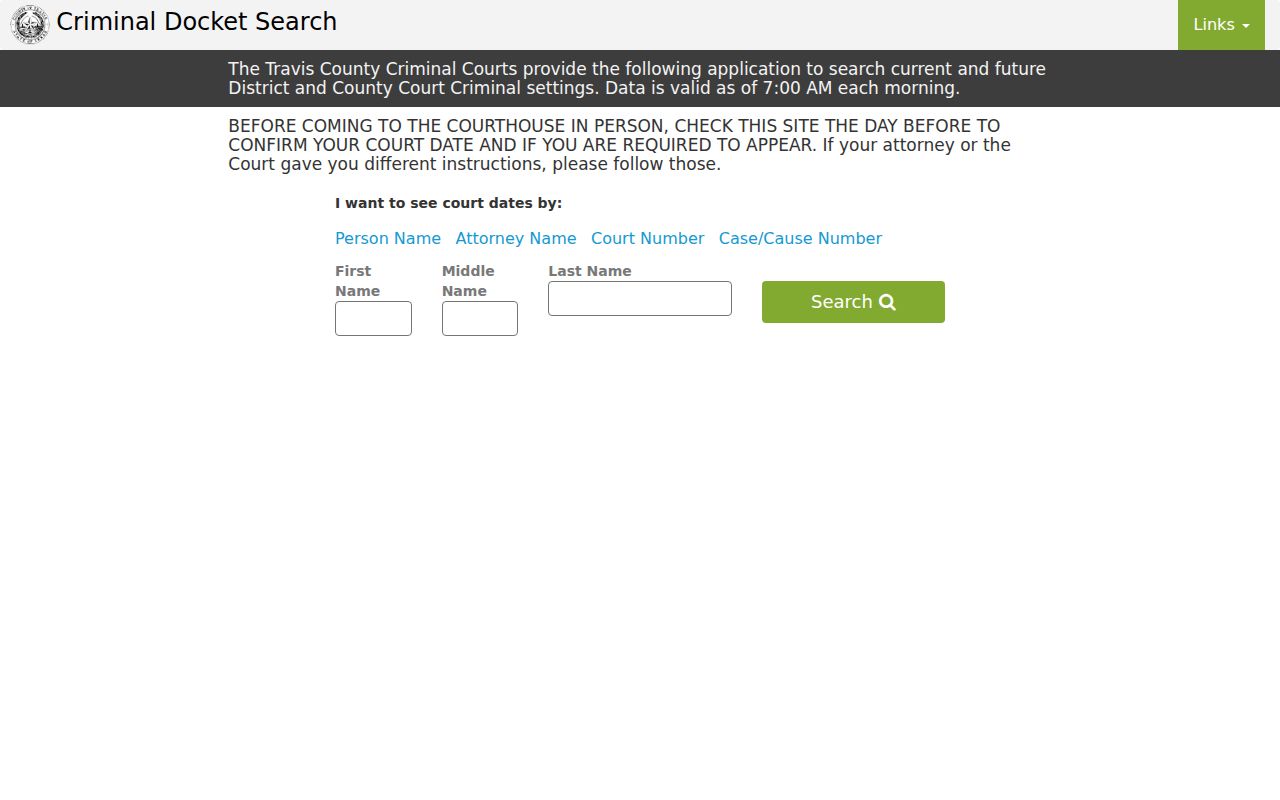
When a setting matters, don't trust the calendar alone. Compare it with the latest notice or signed setting order, then confirm with the court. A last-minute reset may not show up in a posted list right away.
Texas Courts With Criminal Dockets
Start with the Texas court printed on the citation or charging paper. Felony prosecutions generally proceed in District Court, where the District Clerk keeps the criminal docket. Class A and B misdemeanors ordinarily land in a constitutional County Court or County Court at Law, with the County Clerk or another assigned clerk maintaining the file. Statutes and local arrangements can shift that split.
Class C misdemeanors, traffic offenses, and many fine-only cases may go to a Texas Justice of the Peace or Municipal Court. Which one depends on the offense, the issuing agency, geography, and city limits. Those courts keep their own Texas registers, and they may not show up in a countywide portal. Juvenile delinquency matters fall under juvenile jurisdiction, often a District Court or a designated county court, with restricted access rules. An appeal creates a separate record at the intermediate Court of Appeals or the Court of Criminal Appeals.
The Texas county directory points you to the right clerk and local portal. Match the court number and cause number on the record once you get there. A directory identifies local resources; it does not decide which court had jurisdiction.
When a Texas Criminal Case Is Missing
A Texas criminal search that comes back empty does not mean the record is restricted. First, work through the clerk split. A district felony will never appear in a Justice Court search. A city citation may belong to a Municipal Court rather than the County Clerk. Texas misdemeanors can also sit with a different county-level clerk depending on statute and local assignment. Check each office's coverage before giving up.
- Check the exact Texas court, county, cause number, and any prefix or leading zero on the source paper.
- Try the clerk for the court level shown, including the JP precinct or issuing city when relevant.
- Check whether the portal uses filing date, offense date, caption, or a limited archive range.
- Ask the Texas clerk or court coordinator which local register carries the case and whether a public copy is available.
Other things can hide a result too. Restricted juvenile information, a sealed indictment, an expunction or nondisclosure order, or delayed indexing may all affect what the public sees. A missing result alone proves none of them. Use the county directory to contact the right court directly.
Texas Criminal Docket Access Rules
Texas criminal docket access is public in many cases. Statutes, court rules, and case-specific orders all play a part. Some juvenile records are confidential or restricted. That depends on the record, the minor's age, the offense, and later proceedings. A case involving a minor is not automatically hidden in every circumstance. A Texas public docket can stay visible. A particular document may still be redacted or withheld.
Expunction and nondisclosure orders can change what turns up in a general Texas search. The clerk that keeps the docket can explain which access rule applies. It can also say whether a permitted public version exists. For case-file access, contact that clerk. Texas Rule of Judicial Administration 12 covers defined judicial administrative records, not ordinary requests for adjudicative case files. It does not reach elected officials other than judges. The Texas Public Information Act covers certain government records. Courts are excluded in their judicial role.
Key Rules:
Texas Family Code Chapter 58 restricts specified juvenile records, with access tiers and exceptions set by Texas law.
Texas Code of Criminal Procedure Chapter 55A governs expunctions and can affect public criminal-record access.
Texas Government Code Chapter 411, Subchapter E-1 governs nondisclosure orders in covered circumstances.